

The business cycle sensitivity of Nordic assets, which makes them riskier but also offers higher rates of return, tends boost their appeal relative to safer EU-based counterparts in an optimistic market environment. This typically results in a weaker Euro/Nordic exchange rate because investors are prioritizing profits over capital preservation. This flow of capital is underpinned by the interconnected economic network that the Eurozone, Norway and Sweden all share.
THE SWEDEN AND NORWAY-EU RELATIONSHIP: TRADE, ECONOMICS AND THE EUR/SEK, EUR/NOK RATE
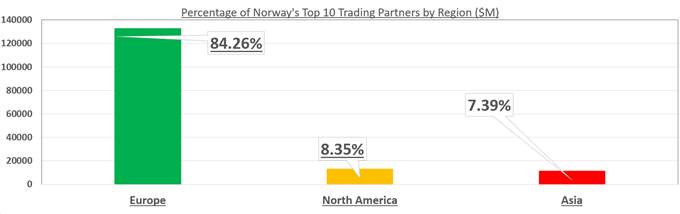
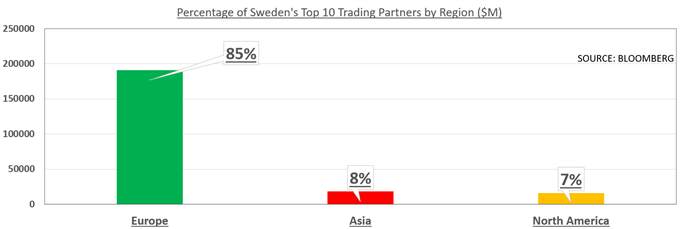
An overwhelming majority of Swedish and Norwegian exports flow to the heart of Europe. Therefore, when investors are buoyant and have a positive outlook on growth, this trading relationship leads to capital running from the core (EU) to perimeter (Nordic) countries. Robust demand from Europe is a crucial source of economic vitality for the outward-facing Scandinavian economies.
European Demand: A Key Destination for Norwegian Exports (2018)
European Demand: A Key Destination for Swedish Exports (2018)
However, during an economic downturn, the direction of capital flows reverses. This frequently results in a stronger Euro/Nordic exchange rate as investors turn more risk-averse and reduce their exposure to riskier assets (such as NOK and SEK). In this regard, the stability and strength of the Eurozone acts as a magnet for investors with capital looking to hold it where it will be comparatively less exposed to volatility.
Even if the Eurozone itself is the epicenter of market turmoil, traders typically prefer to hold their capital in German Bunds or the Euro over their Nordic counterparts. To put it another way: capital flows from perimeter to core in a ‘risk-off’ scenario. In the example below, the EUR/SEK exchange rate strengthened between 2018 and 2019 as political risk in Europe drove the Euro higher because it was viewed as comparatively safer than the Swedish Krona.
Capital Shifts from Perimeter (SEK) to Core (EUR) Assets Amid Market-Wide Risk Aversion
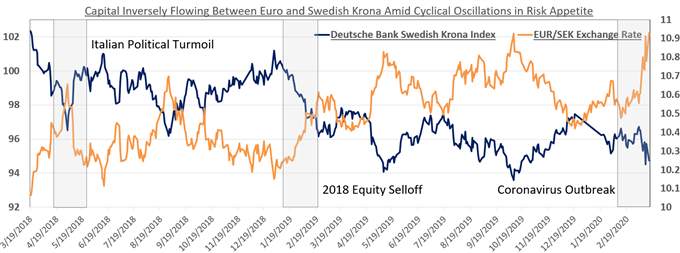
Conversely, as the global economy began to recover from the 2008 global financial crisis, the EUR/SEK exchange rate weakened as risk appetite was revived and traders felt more optimistic about the overall growth outlook. Investors then started to redirect their capital away from the oasis of security in the core (EU) to the comparatively riskier but higher-returning alternatives in the perimeter (Nordics). This relationship reflected a resurrected interest in trading riskier and higher-yielding assets in a less uncertain environment.
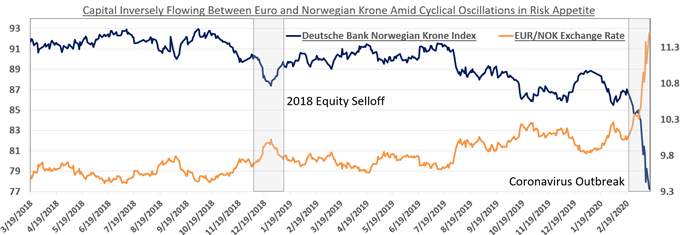
Capital Shifts from Perimeter (NOK) to Core (EUR) Assets Amid Market-Wide Risk Aversion
Crude Oil Prices and the Norwegian Krone: What is the Connection?
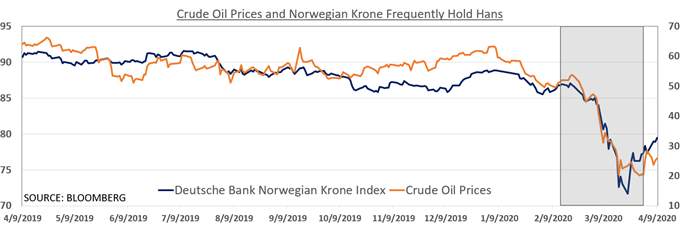
The Norwegian Krone in particular is susceptible to fluctuations in risk appetite due to Norway’s strong connection to the petroleum industry. As a cycle-sensitive commodity, crude oil prices quickly respond to changes in global sentiment because of what that could mean for future demand of a key input in economic growth. NOK, in this regard, is frequently at the mercy of the same forces that influence the commodity.
Norwegian Krone Index and Brent – Daily Chart
--- Written by Dimitri Zabelin, Currency Analyst for DailyFX.com
风险提示:本文所述仅代表作者个人观点,不代表 Followme 的官方立场。Followme 不对内容的准确性、完整性或可靠性作出任何保证,对于基于该内容所采取的任何行为,不承担任何责任,除非另有书面明确说明。

暂无评论,立马抢沙发