


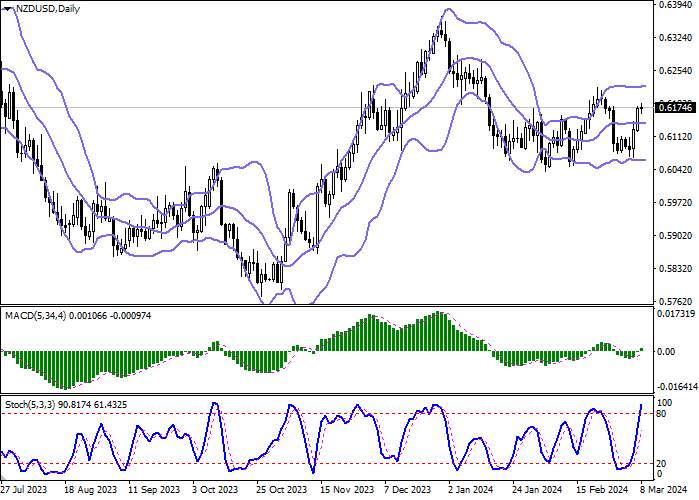
| Scenario | |
|---|---|
| Timeframe | Intraday |
| Recommendation | BUY STOP |
| Entry Point | 0.6185 |
| Take Profit | 0.6217 |
| Stop Loss | 0.6165 |
| Key Levels | 0.6076, 0.6100, 0.6130, 0.6158, 0.6183, 0.6200, 0.6217, 0.6250 |
| Alternative scenario | |
|---|---|
| Recommendation | SELL STOP |
| Entry Point | 0.6155 |
| Take Profit | 0.6100 |
| Stop Loss | 0.6183 |
| Key Levels | 0.6076, 0.6100, 0.6130, 0.6158, 0.6183, 0.6200, 0.6217, 0.6250 |
Current trend
During the Asian session, the NZD/USD pair shows ambiguous trading dynamics, consolidating near 0.6170 ahead of the American labor market data release.
Analyst forecasts suggest a slowdown in the February nonfarm payrolls from 353.0K to 200.0K. The unemployment rate may remain at 3.7%, and the average hourly wage will slow down from 4.5% to 4.4% YoY and from 0.6% to 0.3% MoM.
Investors continue to analyze the Reserve Bank of New Zealand’s (RBNZ) decision to leave interest rates at 5.50%. At the same time, the regulator lowered its forecast for the peak value from 5.70% to 5.60%, softening its “hawkish” position and hinting that there are no plans to tighten monetary stimulus. Chief economist Paul Conway said the core consumer price index and most measures of inflation expectations had eased, and risks had become more balanced. He noted that officials could adjust borrowing costs sooner than expected if the US Federal Reserve moves to the “dovish” rhetoric this year.
In addition, traders focus on yesterday’s publication of data on China’s foreign trade: export volumes from China in February accelerated from 2.3% to 7.1%, significantly ahead of an expected slowdown to 1.9%, and imports grew from 0.2% to 3.5%, above market expectations of 1.5%, as a result of which the trade surplus rose from 75.34B dollars to 125.16B dollars, while experts expected 103.7B dollars.
Support and resistance
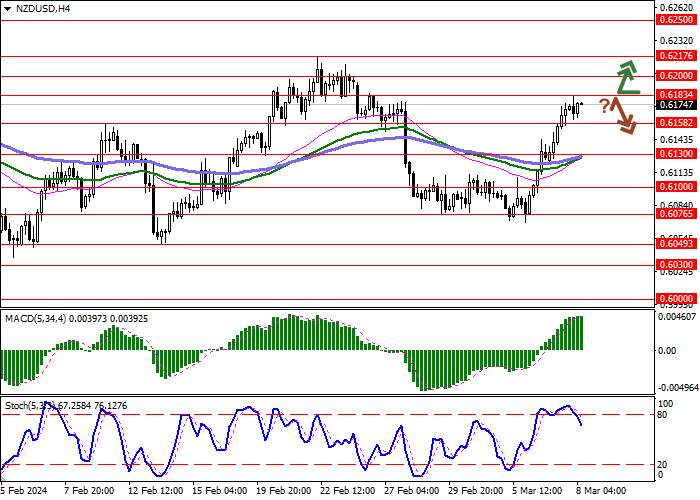
On the daily chart, Bollinger Bands are moving flat: the price range changes slightly, remaining wide enough for the current market activity. The MACD indicator is growing, maintaining a strong buy signal: the histogram is above the signal line and is trying to consolidate above the zero level. Stochastic maintains a confident upward direction but is near the highs, reflecting that the New Zealand dollar may overbought in the ultra-short-term term.
Resistance levels: 0.6183, 0.6200, 0.6217, 0.6250.
Support levels: 0.6158, 0.6130, 0.6100, 0.6076.
Trading tips
Long positions may be opened after a breakout of 0.6183, with the target at 0.6217. Stop loss – 0.6165. Implementation time: 1–2 days.
Short positions may be opened after a rebound from 0.6183 and a breakdown of 0.6158, with the target at 0.6100. Stop loss – 0.6183.
风险提示:本文所述仅代表作者个人观点,不代表 Followme 的官方立场。Followme 不对内容的准确性、完整性或可靠性作出任何保证,对于基于该内容所采取的任何行为,不承担任何责任,除非另有书面明确说明。

暂无评论,立马抢沙发