



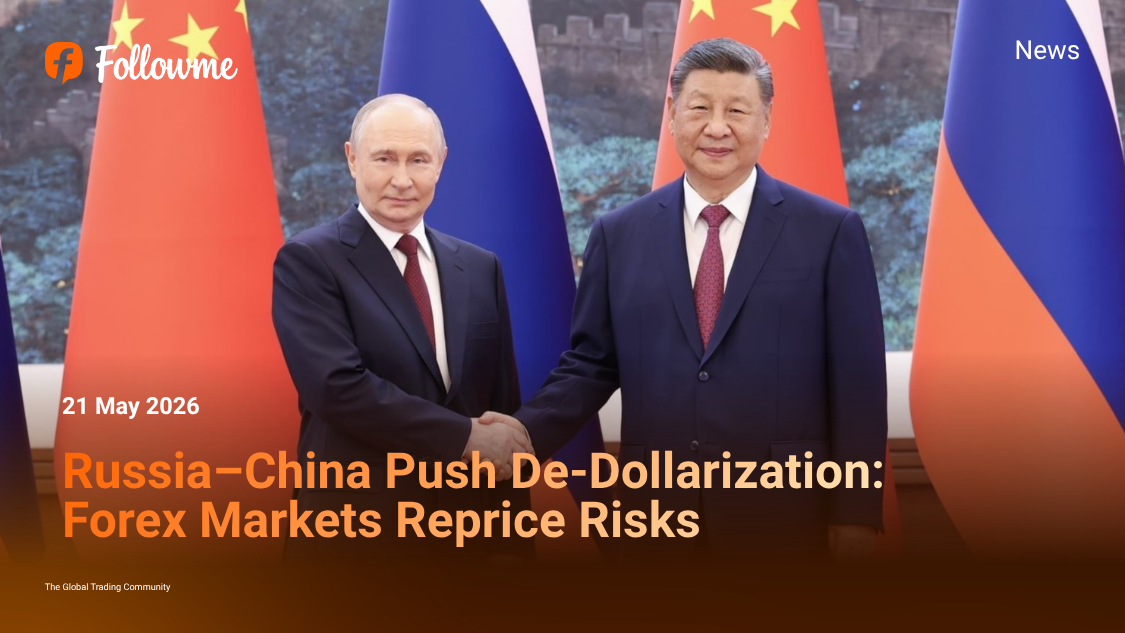
Russia–China expand strategic cooperation after summit
Following the recent summit, Russia and China announced a series of cooperation agreements covering energy, trade, technology, and international payment systems. The agreements suggest that the relationship between the two countries is evolving beyond diplomacy into a long-term economic and strategic alliance. Most importantly, both sides continue expanding energy cooperation while increasing the use of local currencies instead of relying entirely on the U.S. dollar. This is a key development closely watched by Forex markets because it directly impacts the long-term role of the USD within the global financial system. As Russia continues facing Western sanctions, China has become a critical partner helping Moscow maintain energy exports and stabilize capital flows. In return, China benefits from discounted Russian energy supplies to support economic growth and strengthen energy security amid rising global competition.
Connection to the Trump–Xi meeting: China is balancing between the U.S. and Russia
The key issue markets are now focusing on is not simply Russia–China or U.S.–China relations individually, but rather how China is strategically balancing both global powers. The recent Trump–Xi meeting carried the goal of reducing trade tensions, stabilizing supply chains, and preventing a deeper global economic slowdown. Markets initially viewed the meeting as a possible starting point for a new phase of U.S.–China de-escalation. However, China’s decision to strengthen strategic cooperation with Russia immediately afterward signals that Beijing has no intention of fully aligning with Washington or the Western bloc. Instead, China appears to be pursuing a “multi-polar strategy”, maintaining economic ties with the U.S. while simultaneously deepening strategic partnerships with Russia to reduce dependence on Western-led financial and trade systems. This is highly significant for Forex markets because it directly affects:
- the long-term role of the U.S. dollar,
- the internationalization of the Chinese yuan,
- global energy pricing,
- and worldwide safe-haven capital flows.
Forex impact: USD, yuan, and global capital flows remain the key focus
1. USD: Supported in the short term but facing long-term pressure
In the short term, geopolitical uncertainty continues to support the U.S. dollar due to its safe-haven status. Whenever markets fear conflict escalation, economic fragmentation, or energy disruptions, capital typically flows back into the USD. However, over the longer term, the growing use of local currencies between Russia and China is leading markets to question whether global dependence on the dollar could gradually decline. While this is not enough to challenge the USD’s dominance immediately, it is creating a new long-term narrative that investors are watching much more closely.
2. Chinese yuan: Expanding international influence
The Russia–China partnership is also strengthening the global role of the Chinese yuan as China increasingly uses the currency for energy trade and cross-border transactions. If this trend continues, the yuan could gradually become a more influential regional currency across Asia and emerging markets. However, markets remain cautious because the yuan is still not fully liberalized like the USD.
3. Oil and gold: Benefiting from geopolitical uncertainty
Russia remains one of the world’s largest energy exporters, while China is the largest energy consumer. Their deepening strategic relationship is raising concerns that global energy supply chains could become increasingly fragmented in the future. As a result, oil prices remain highly sensitive to geopolitical developments, while gold continues to benefit from its role as a major safe-haven asset during periods of global uncertainty.
Market Overview
Forex markets are increasingly entering a phase where geopolitics carries greater influence than traditional economic data. If the Trump–Xi meeting represented an effort to stabilize global trade, the Russia–China summit highlighted a broader shift toward a more multi-polar world, where countries are actively seeking to reduce dependence on the U.S.-led financial system. This leaves markets caught between short-term hopes for economic stabilization and long-term concerns about structural changes in global capital flows and the international monetary system.
Want to stay ahead of major macro developments that move the Forex market?
👉Follow Followme and check out the Weekly Economic Calendar




风险提示:本文所述仅代表作者个人观点,不代表 Followme 的官方立场。Followme 不对内容的准确性、完整性或可靠性作出任何保证,对于基于该内容所采取的任何行为,不承担任何责任,除非另有书面明确说明。

-THE END-