



GEOPOLITICS MARKET REVIEW Global Markets
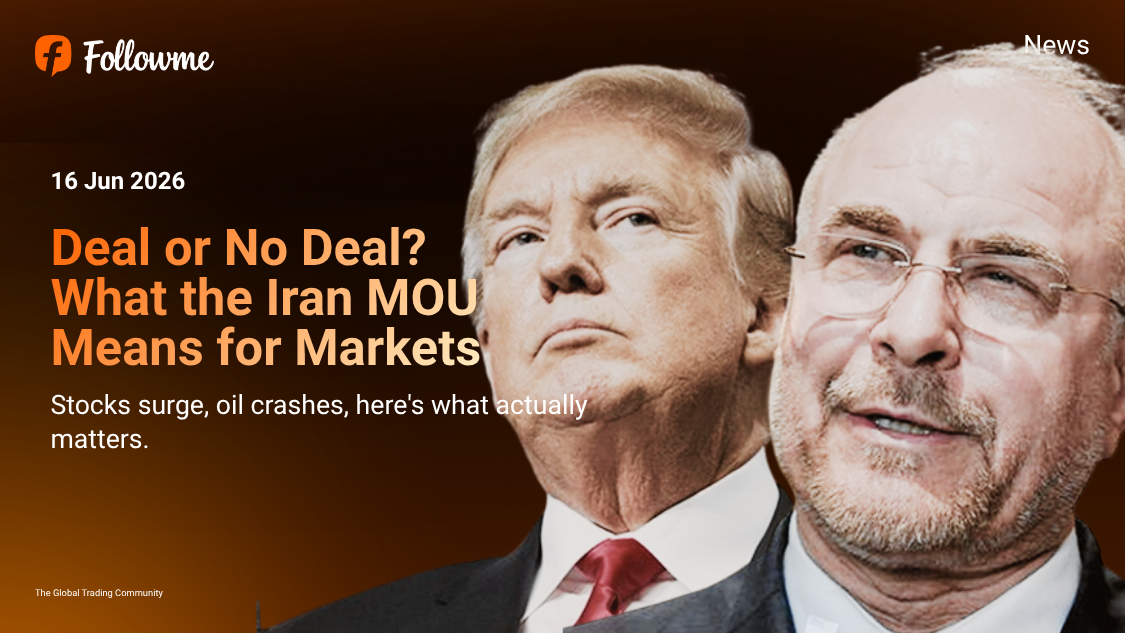
Deal or No Deal? What the Iran MOU Means for Markets
The US and Iran signed a landmark Memorandum of Understanding to end their conflict — oil cratered 40% from its peak, the Strait of Hormuz reopens, but the fine print leaves plenty of room for a reversal.
Followme News Desk | June 18, 2026 | Source: Reuters, Trading Economics, White House
Monday, June 16 turned out to be one of the most eventful trading sessions in months. News of a US-Iran Memorandum of Understanding aimed at ending their conflict broke over the weekend, and markets wasted no time reacting. Stocks surged, oil cratered, and traders are now watching closely as both sides move to implement the agreement's terms — but the headline looks cleaner than the reality underneath.
What's in the Deal?
The MOU was signed electronically on Sunday, June 15 by US Vice President JD Vance and Iranian Parliament Speaker Mohammad-Bagher Ghalibaf, with President Trump present as a witness. Three days later on Wednesday June 17, both President Trump and Iranian President Masoud Pezeshkian separately signed the document — Trump during a dinner with French President Emmanuel Macron at the Palace of Versailles. Both sides have confirmed the agreement is now fully in effect.
A previously announced formal signing ceremony in Geneva was subsequently called off. Iran's Foreign Ministry spokesperson confirmed no in-person ceremony would be held in Switzerland, given the MOU had already been executed digitally. Technical-level talks are still expected to take place in Bürgenstock, Switzerland on Friday — but this is a working session, not a signing event.
Verified Key Terms of the 14-Point MOU
- Immediate and permanent end to military operations on all fronts, including Lebanon
- US naval blockade begins lifting immediately upon signing; fully ended within 30 days
- Strait of Hormuz open to commercial vessels with no toll — for 60 days only
- Iran to complete demining and restore full vessel passage within 30 days
- Iran commits to not procuring or developing nuclear weapons; HEU stockpile disposition to be negotiated
- US Treasury issues Iranian oil export waivers immediately upon signing
- Frozen Iranian assets (~$100 billion) made “fully available” — release procedures agreed during 60-day talks
- US and regional partners to develop a $300 billion reconstruction fund for Iran
- Final deal to be endorsed by a binding UN Security Council resolution
- 60-day window to reach a final agreement, extendable by mutual consent
One important detail on assets: while the MOU commits the US to making frozen Iranian funds “fully available,” zero assets have been released yet. The exact procedures for accessing those funds will be negotiated during the 60-day window. Oil export waivers, however, take effect immediately. Full sanctions relief is tied to Iran maintaining compliance through to a final deal.
Oil: Sharp Drop, Then Continued Decline
Oil was the most dramatic mover. Brent fell below $80 per barrel on Monday on reports the US would allow Iran to sell oil immediately, erasing much of the geopolitical risk premium built up during the Gulf conflict. The decline did not stop there — by Wednesday, Brent had slid to around $78 per barrel, its lowest level since early March, falling for the fifth consecutive session. WTI tracked similarly in the $75–$77 range.
Brent: ~$78/bbl | WTI: $75–$77/bbl | Drop from conflict peak: ~40% | Sessions falling: 5 consecutive
“Brent fell toward $78 per barrel on Wednesday, sliding for the fifth straight session and reaching its lowest level since early March.”
— Trading Economics, June 17, 2026
Questions remain over maritime security, insurance costs, and how long it takes stranded vessels to return to service — restoring shipping routes could take weeks or months. The International Energy Agency warned of a looming supply glut, projecting global oil supply to increase by 8 million barrels per day by 2027, against demand growth of only 2 million bpd. Even with the Strait reopening, the structural picture for oil is not bullish.
Iran's chief negotiator Ghalibaf also introduced a note of uncertainty, warning that the Strait “will never return to pre-war conditions” and that Iran will expect to “receive a fee for services” after the 60-day toll-free period. The Trump administration has pushed back on this, arguing Gulf states would never accept a tolled strait. That tension remains unresolved and is a live risk for the market.
What Traders Should Watch This Week
This is not a “set and forget” kind of market. Here’s where to keep your eyes:
- Brent Crude / WTI — The major drop has already happened. The next question is whether demining and vessel repositioning proceed smoothly, and how quickly Iranian barrels re-enter markets. Any implementation snag and prices snap back up sharply.
- XAU/USD — Gold — Dollar softened on peace optimism, supporting gold. Fed signals this week remain a key reversal risk. If policymakers sound hawkish, both could unwind fast.
- Nasdaq — Riding the AI wave but sensitive to any macro surprise from the Fed or a breakdown in MOU implementation.
- Strait of Hormuz tolls (post-60 days) — Ghalibaf's comments about future fees are not priced in by markets. Watch for whether the final-deal negotiations bring clarity or conflict on this point.
- Israel-Lebanon — The MOU explicitly requires Israel to terminate its war in Lebanon as part of the broader ceasefire. PM Netanyahu said he and Trump “do not always see eye to eye,” leaving the Lebanon front as a meaningful implementation risk.
The US-Iran MOU is genuinely significant — the most concrete step toward de-escalation since the conflict began in February 2026. But markets have a habit of front-running the best-case scenario, and there is enough ambiguity here — the mine-clearing timeline, Netanyahu’s posture, Iran’s conflicting statements on Hormuz fees, and a watchful Fed — to keep things interesting through the end of the week and well beyond.
The technical talks in Bürgenstock on Friday are the next event to watch. If both sides confirm the same terms and implementation begins smoothly, the risk-on rally likely has legs. If it doesn’t, expect a sharp reversal across energy, equities, and safe-haven assets all at once.
● This is a developing story. Watch for updates following the Bürgenstock technical talks on Friday.
Want to stay ahead of major macro developments that move the market? Follow us for daily market insights, analysis, and the tools you need to trade with confidence.
Want to stay ahead of major macro developments that move the Forex market? 👉 Follow Followme and check out the Weekly Economic Calendar




风险提示:本文所述仅代表作者个人观点,不代表 Followme 的官方立场。Followme 不对内容的准确性、完整性或可靠性作出任何保证,对于基于该内容所采取的任何行为,不承担任何责任,除非另有书面明确说明。

-THE END-